"I have submitted 676 applications ... And of those 676 I have converted into six interviews."
Technical program manager, on a call with Sam
🏠 The Ultimate Job Search Guide
<aside>
📈
A written plan, by itself, raises your odds. In a randomized study in South Africa, job seekers who made a job search plan got 30% more job offers and were 26% more likely to be employed at follow-up, without spending more time searching (Abel, Burger, Carranza and Piraino, 2019).
</aside>
Before you start: know your limits
Write these down before you send a single application:
- Income: how long can you go without a paycheck? Count how many months your savings will cover. In our Q1 2026 survey, 46% of job seekers had less than 3 months saved. Only 55% of US adults have 3 months saved (Federal Reserve, 2025).
- Location: where can you work, and would you move?
- Tip: if you would move, put the city you want to move to at the top of your resume, not your home address. "Relocating to Denver, CO" tells the recruiter you're ready and keeps your address from screening you out.
- Work authorization: where can you legally work, and do you need sponsorship? This gets complex, and every case is different. Be upfront about your status, and look for employers that hire people with it.
- Schedule: which hours can you work, and how many can you spend searching each week? Plan on 15 to 30 minutes per application. At the 10 to 20 a week I suggest below, that's 2.5 to 10 hours a week, or 30 minutes to 2 hours a weekday.
- Caregiving: who else depends on your time?
Pick your path
Your limits decide which path you take. If you need income now, run both at once.
<aside>
⚡
Path 1: You need a job soon
- Aim for the title you just had. That's the title you're most likely to get interviews for. Resumes whose title matched the posting had a 10.6x higher interview rate in Jobscan's study of 2.5 million applications.
- Look at onsite and hybrid jobs too. Remote-only applications had a 3.53% interview rate in Q2 2026, against 5.86% onsite and 6.07% hybrid.
- Take interim work if you need it. Interim work does not erase your experience.
- Just laid off? Start with If you were just laid off.
</aside>
<aside>
🧭
Path 2: You have time to reach
- Aim higher or change fields if you have a job or savings to lean on.
- Change 1 thing at a time. Keep your industry and change your function, or keep your function and change your industry.
- Changing both takes stronger proof, such as a relevant project, internal assignment, or paid contract.
- See where people from your field apply in our career changer research, and how they wrote the switch in our career change resume examples.
</aside>
Changing careers? See where people from your field go
70.3% of 15,175 Huntr job seekers applied outside the field on their resume. In Operations, 82.9% did. The most common route was Software & IT to Data & Analytics, taken by 722 people. Our career changer research maps 26 fields. Pick yours to see the 3 fields its people apply to most, and the 3 that send the most people your way.
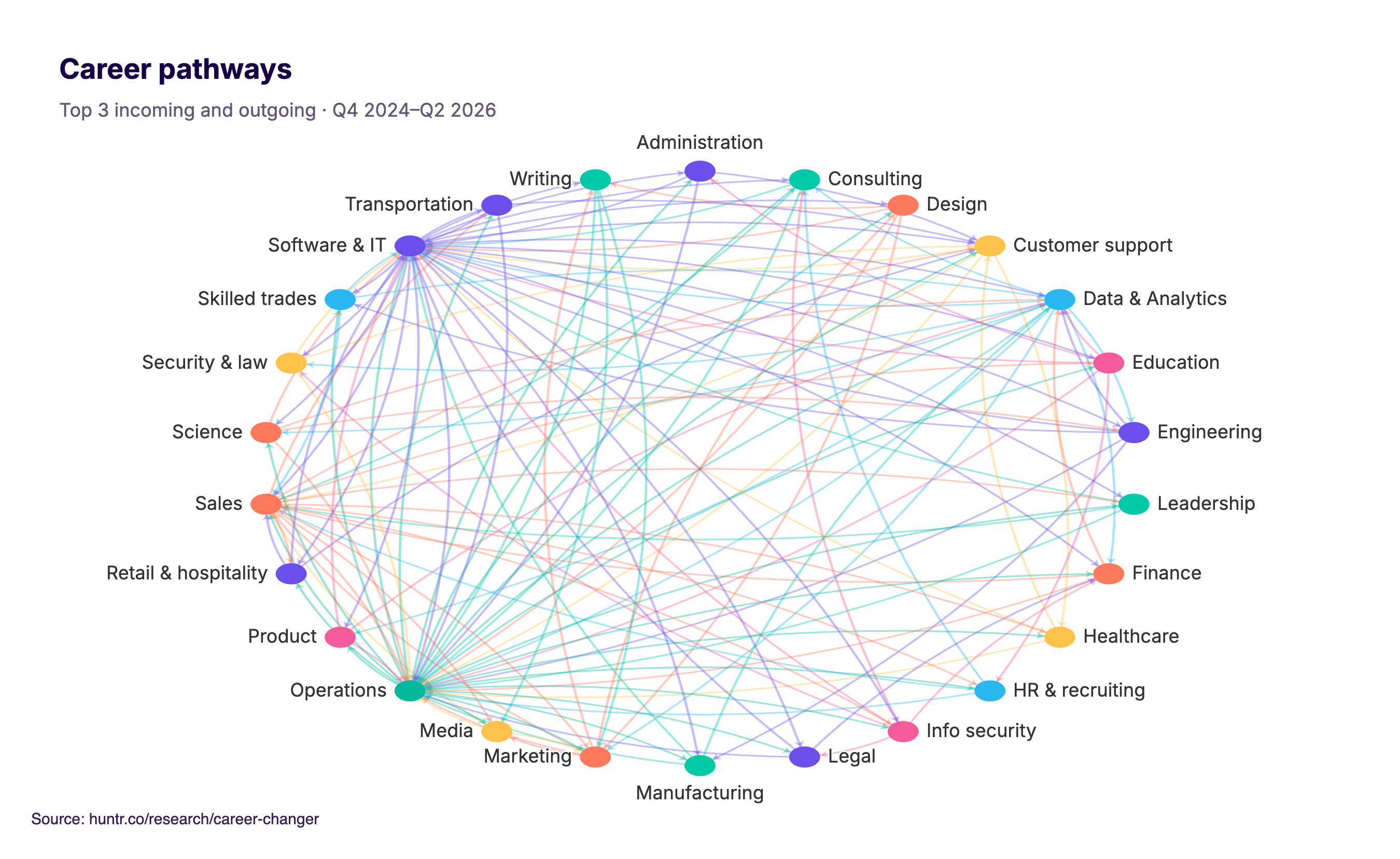
Career change statistics 2026: where job seekers apply
Open the interactive career change chart · See career change resume examples
Build your plan in 3 steps
Step 1. Choose one target role. Pick it from your path above, then add a few nearby titles that describe the same work. Read the duties in each post. A "customer success" job might center on adoption, renewals, support, or selling, and each calls for different evidence. You can change the target later.